Fashion
Why Fashion Brands Are Hosting More Private Client Dinners
written by laiba sheraz

Hermès dinners, Chanel temples, Mytheresa ski clubs. Inside the private-client circuit, where the menu is bespoke, the guest list is microscopic, and admission begins at roughly $200,000 a year.
The runway, that grand twentieth-century invention, has competition. Her name is the dinner party.
In June 2025, Chanel flew a microscopic guest list to a private temple in Kyoto for a single evening with the new Reach for the Stars high jewelry collection. There was no front row. There was no livestream. There were forty-some guests, one set of doors that closed at dusk, and a maquillée discretion that would have made Coco proud. A month earlier, in Rome, Bulgari unveiled the latest Serpenti pieces in an invitation-only presentation that operated by the same principle: less, better, quieter, costlier.

Photo: Bulgari Serpenti pieces
This is the new architecture of luxury marketing. Hermès has run the model for nearly a decade through its Beyond the Walls dinners, a touring program of artisan demonstrations, theatrical staging, and dishes built around the house’s heritage. Prada Mode, the brand’s roving cultural club, set up in Abu Dhabi this February with artist Theaster Gates and a guest list shorter than most rehearsal dinners. Mytheresa, the German luxury e-tailer with a sharp instinct for the resort calendar, parked a private club on Via Serlas in St. Moritz this winter, open through April 6, invitation only, complete with trunk shows, styling appointments, and the kind of après-ski that does not appear on Instagram.
*Insert Video*
Video: Hermès Beyond the Walls dinner
I couldn’t help but wonder: when did the most powerful piece of paper in fashion become the place card?
The numbers explain. At Louis Vuitton, Chanel, and Hermès, the spending threshold that unlocks the true VIC tier, bespoke commissions, advance access, and the call from the directrice, begins at roughly $200,000 a year. That figure buys not just product but proximity, and proximity is the asset the houses now optimize for. A campaign reaches millions. A dinner reaches twelve, and those twelve outspend the millions by a comfortable multiple.
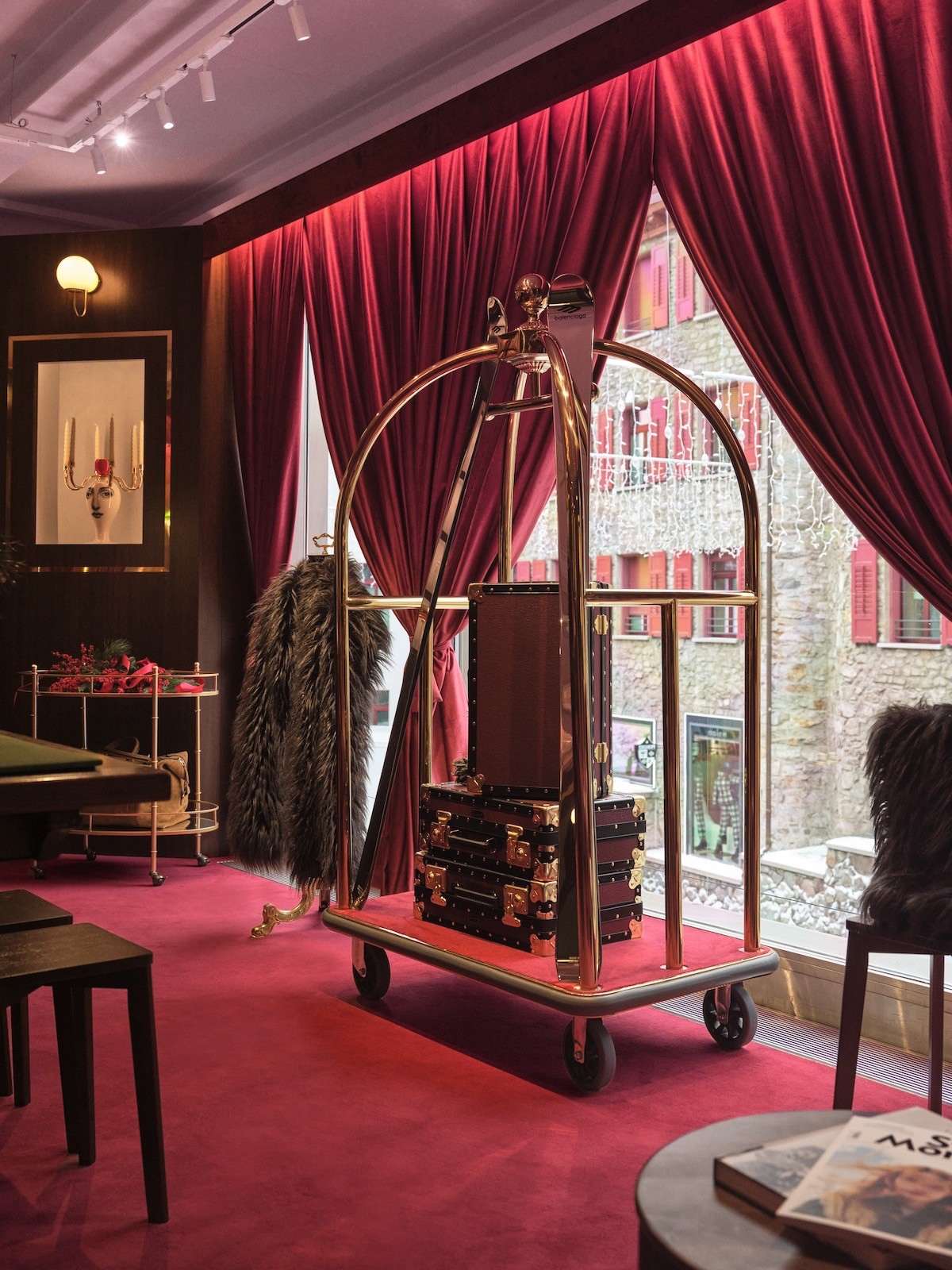
Photo: Mytheresa St. Mortiz
The choreography is exquisite. A VIC is collected from her plane. She is moved through an experience scripted to the second: a vintage Fiat 500 motorcade through Turin’s historic center, a private dinner on the stage of the Teatro Regio, arias from La Bohème performed afterward by singers from the resident company. The brand calls this hospitality. The accountant calls it client retention. Both are correct.
The strategy is not new. Hermès’s saddle workshop has always done private commissions; Boucheron has always cleared its Place Vendôme salon for a single client. What is new is the program. The dinner is no longer a courtesy. It is a marketing line item, often the largest one, and it is replacing the spectacle that used to drive a season. A Met Gala buys 24 hours of cultural attention. A correctly executed Kyoto evening buys a relationship that compounds for decades.
There is a fashion-industry instinct to romanticize this. The closed door, the candlelight, the artisan flown in from Faubourg Saint-Honoré to demonstrate the inside of a Birkin, these are sincere. They are also a brilliantly cynical response to a saturated market in which everyone has, technically, seen everything. Scarcity is the last lever the houses pull, and they are pulling it harder than they have in a generation.

Photo: Prada Mode Abu Dhabi with Theaster Gates
For the rest of us, the customer with a single Picotin and a sense of irony, the takeaway is structural. The most important runway in fashion now seats fourteen, serves a tasting menu, and ends at midnight. You will not see it on TikTok. There is no influencer in the room. There is a sommelier, a directrice, an artisan in a worn linen apron, and the kind of silence that costs more than the wine. That is exactly the point.