Runway
Thom Browne Haute Couture: America's Master Tailor
written by laiba sheraz

Somewhere in the gilded belly of the Palais Garnier, Thom Browne once seated an audience of 2,000 identical men in gray flannel suits, none of whom clapped, blinked, or RSVP'd. They were cardboard. The real guests, the ones who could applaud, sat facing them, watching the American tailor from Allentown, Pennsylvania do something no one from his side of the Atlantic had pulled off with quite this much nerve: debut a haute couture collection on the official Paris calendar.
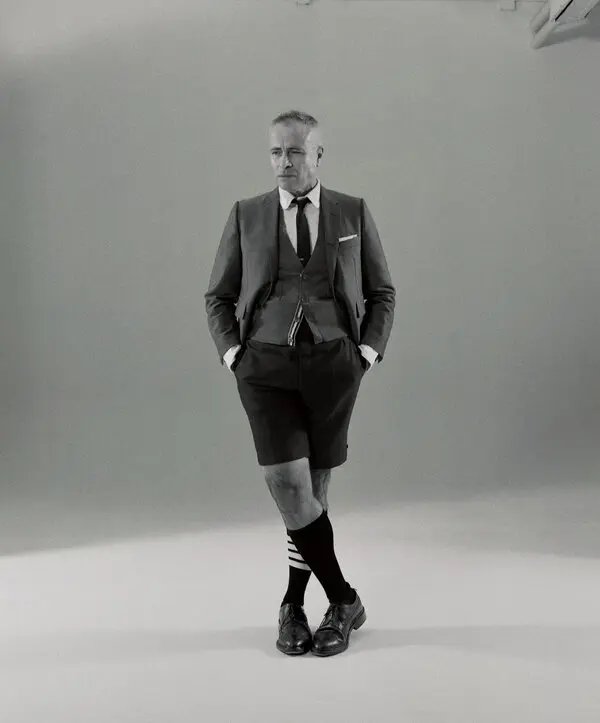

That was 2023. Browne, admitted as a guest member of the Chambre Syndicale de la Haute Couture, became the rare American name stitched into a roster otherwise dominated by houses with two-hundred-year head starts. It was not a polite entrance. It was theater, precision, and a wink, delivered simultaneously, which, if you have ever met the man in his own gray suit and cropped trousers, is exactly on brand.

By Fall/Winter 2024-25, Browne had raised the stakes considerably, staging an Olympic-inspired couture spectacle timed to the Games arriving in Paris that summer. The clothes were not merely elaborate; they were engineering feats. The beadwork alone, cascading across coats and pencil skirts in dense, glittering formation, consumed 11,000 hours and required 42 artisans working in concert. Consider that figure for a moment. Eleven thousand hours is roughly fifteen months of nonstop labor, dedicated entirely to the surface of a coat.
And then there is the muslin, humble, undyed, the fabric every design student uses for a first, disposable draft. Browne built all 48 looks from it, elevating the ordinary building block of the atelier into the finished product itself, a sly argument that couture's real luxury has always been the process, not the polish. He is famous for hand-basting his garments the old-fashioned way, temporary stitches sewn by hand before the permanent ones go in, a technique most houses now delegate to a machine and a prayer. Browne keeps it manual. It is the fashion equivalent of insisting on a rotary phone because you like the sound of the dial.
What makes Browne's couture chapter genuinely interesting is not that he plays dress-up with tradition, plenty of designers do that, but that he treats spectacle and craftsmanship as the same instinct rather than opposing forces. The cardboard men, the Olympic beading, the insistence on hand technique: these are not competing impulses toward "fun" versus "serious." They are, in Browne's telling, the same sentence. "The construction of everything is very serious," he has said, "but I wanted to make sure that it had a very light-hearted kind of feel to it." That is, in essence, the whole Thom Browne thesis, delivered with the gray-suited deadpan of a man who has never once cracked a smile on a runway and has never needed to.